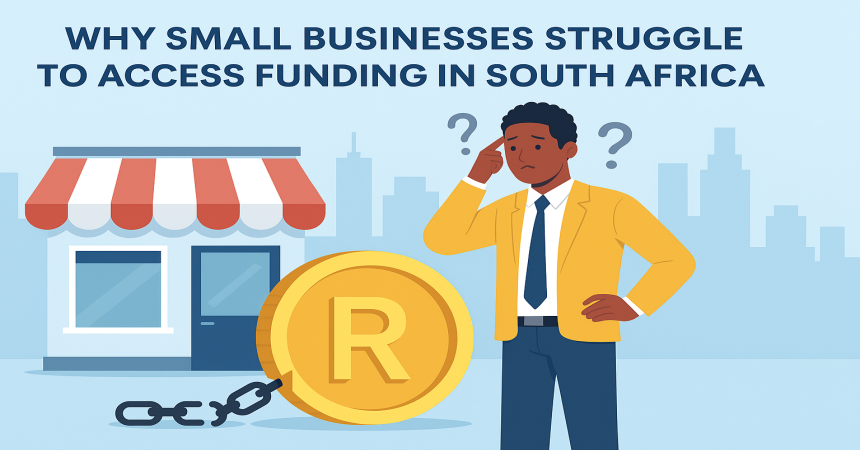
Accessing business finance in South Africa is often difficult for entrepreneurs and SMEs. Learn why traditional lenders say no — and how modern digital lenders are changing the story.
Why Small Businesses Struggle to Access Funding in South Africa
For many South African entrepreneurs, access to finance is one of the biggest barriers to growth. Despite government initiatives and numerous financial institutions, small businesses still find it difficult to secure the funding they need to expand, hire, or even survive.
Here’s why that happens — and how modern lenders are bridging the gap.
1️⃣ Limited Access to Collateral and Credit History
Traditional banks still rely heavily on collateral-based lending, requiring property, vehicles, or fixed assets to secure a loan.
Most SMEs — especially startups — simply don’t have those kinds of assets.
At the same time, South Africa’s credit system often excludes informal or newly registered businesses that don’t yet have a track record with credit bureaus, making approvals almost impossible under traditional models.
2️⃣ Slow Approval Processes
Conventional lending involves manual documentation, in-person meetings, and multiple layers of approval.
For entrepreneurs who need fast access to working capital, these delays can be crippling — a missed opportunity can mean the difference between survival and closure.
Digital lenders like PienaarBank solve this by using electronic KYC, automated scoring, and secure online submissions, cutting approval times from weeks to days.
3️⃣ High Administrative Requirements
Banks often ask for audited financial statements, tax clearance certificates, and multiple months of transactional data.
Many small businesses — especially those in informal or cash-based sectors — struggle to produce these documents.
By contrast, digital lenders can assess real-time affordability using bank statements, sales data, and verified ID uploads through an online system.
4️⃣ Risk Perception and Economic Uncertainty
Since the COVID-19 pandemic, South African lenders have become more cautious about business credit.
SMEs are often seen as high-risk, particularly in sectors such as transport, retail, and construction.
However, responsible alternative lenders are proving that structured microfinance, supported by technology, can still deliver excellent repayment performance when loans are personalised and transparent.
5️⃣ The Rise of Digital Microfinance
Fintech platforms like PienaarBank represent a new generation of South African lenders that combine speed, simplicity, and compliance.
Borrowers can now apply online, submit KYC documents digitally, and receive funds directly into their ABSA bank accounts — all within a matter of days.
This shift is helping legitimate small businesses grow without the red tape of old banking systems.
Final Word
Access to finance shouldn’t depend on the size of your business — only on your integrity and potential.
At PienaarBank, we believe every entrepreneur deserves the chance to succeed, and we’re here to make that possible with structured, transparent, and fair lending.
Empowering business growth — one loan at a time.